SwarmCitadel Research

Technical papers on AI agent governance, compliance architecture, and regulatory frameworks.

Implementing the MGF for Agentic AI: An Implementor's Architecture Mapping

SwarmCitadel Research · July 2026

Last updated: July 2026

Singapore's Model AI Governance Framework for Agentic AI, published by IMDA and the AI Verify Foundation and substantially updated in May 2026, is the first national framework written specifically for AI systems that plan, reason, and act autonomously. It is principles-based by design: it tells deployers what must be true of their governance posture, not how to build it. That leaves a gap between the framework's four dimensions and a working system architecture.

This paper closes that gap from an implementor's seat. For each MGF dimension it sets out what the framework asks, what an architecture must provide to answer it, and the questions a deployer should put to any governance vendor. It examines the May 2026 update's expanded treatment of multi-agent systemic risk, cascading failure, third-party agents, and automation bias, and argues that three properties now separate aligned architectures from the rest: cross-agent telemetry correlation, policy-defined graduated containment, and boundary-level enforcement that requires no agent code changes. It closes with a practical adoption path, from gateway deployment in front of existing agents to a four-week proof of concept.

Written for compliance leaders, platform owners, and architects deploying agents in regulated environments.
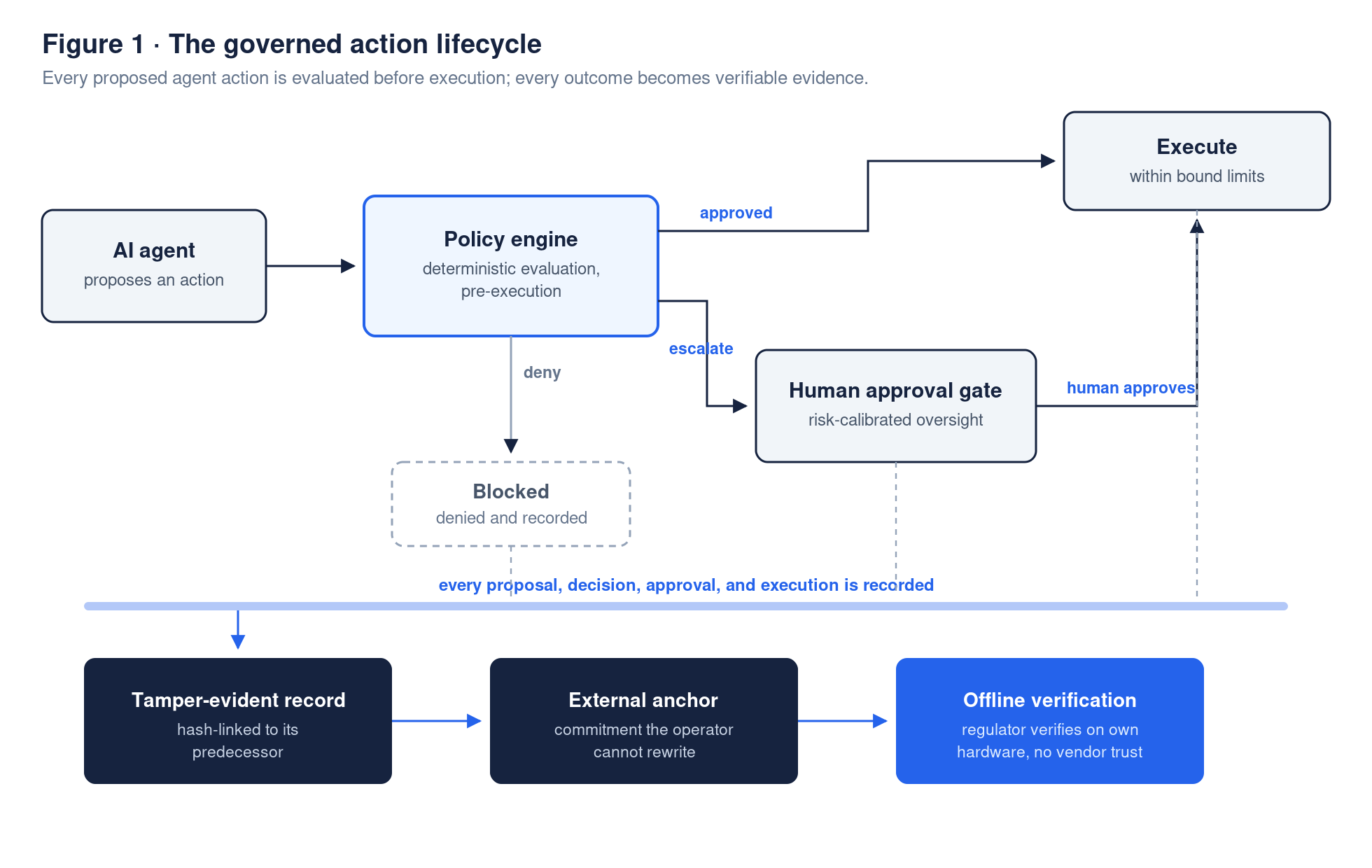
Governed AI agent action lifecycle: policy evaluation, human approval, tamper-evident audit record, offline regulator verification.

Figure 1. The governed action lifecycle. Every proposed action passes through deterministic policy evaluation before execution.

Get the full paper

Enter your email below and we will send you the complete paper.

Frequently Asked Questions

What is the Model AI Governance Framework (MGF) for Agentic AI?

A framework published by Singapore's IMDA and the AI Verify Foundation, first released in January 2026 and updated in May 2026. It is the first national governance framework written specifically for AI agents that plan, reason, and act autonomously, organised around four dimensions: risk assessment, human accountability, technical controls, and end-user responsibility.

How is governing an AI agent different from governing an AI model?

Model governance evaluates a model before deployment: bias, drift, robustness. Agent governance operates at runtime, on actions: was this action authorised, did it comply with policy, who approved it, and can that be proven to an auditor afterwards. Regulated deployments need both layers.

How can an organisation prove an AI agent's actions to a regulator?

Through tamper-evident records: each agent action recorded with its policy evaluation and approver, cryptographically linked in sequence, anchored to an external commitment the operator cannot rewrite, and exportable in a bundle a regulator can verify offline on their own hardware.

Can AI agent labor be measured for workforce and tax reporting?

Yes. Human-equivalent-work measurement calibrates agent output against human baselines for the same task classes, producing auditable labour-hour attribution per agent. This supports workforce-impact reporting today and prepares organisations for AI labor taxation regimes under discussion in several jurisdictions.

Does governance require changing existing AI agents?

Not necessarily. A gateway deployment intercepts agent traffic at the boundary with no agent code changes, which also makes third-party agents governable. Teams building their own agents can integrate an SDK for deeper telemetry.

Ready to implement governed AI agents?

See how SwarmCitadel's architecture maps to the MGF dimensions in practice.

Quick Contact

We'll respond within 24 hours